Approach a Short Ball: Move, Adjust, Hit and Prepare for the Reply
Court-Application Lesson · Philipp Halfmann, M.S. Exercise & Sports Science
Use this short-ball approach footwork drill to connect forward travel, final spacing adjustments, the approach shot and preparation for the reply. Begin with a known forehand-side feed and a clear shot target.
Player not loading? Open This Lesson Video Directly. The full transcript is available below.
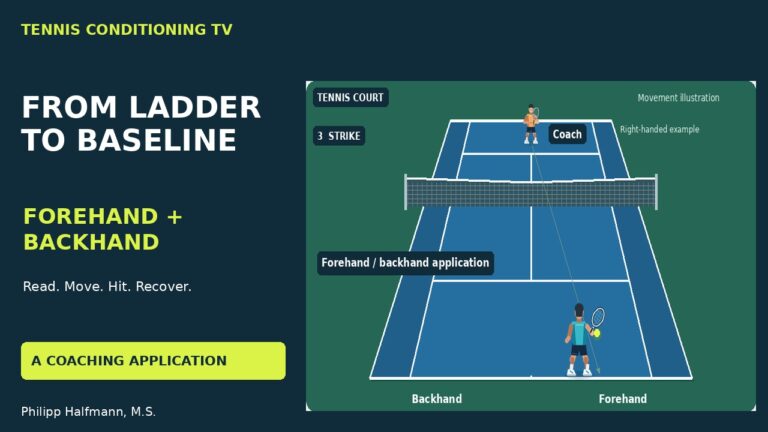
The court animation illustrates the drill layout and teaching sequence. It is not filmed performance or a model swing. The diagram assumes a right-handed forehand; mirror it for a left-handed forehand. Narration uses a synthetic catalogue voice.
Build The Short-Ball Approach Footwork Drill
- Choose a manageable, known forehand-side short feed.
- Cover the forward distance, then organise spacing near the ball.
- Set up and hit toward a stated target, without imposing a compulsory stop or stance.
- Continue forward into the planned ready position for the reply. Reset only between separate repetitions.
What To Observe
Assess usable spacing at contact, control toward the intended target, and readiness for the next reply. Increase one demand at a time. A predictable short feed does not test whether the player can choose between approaching and staying back.
Lesson Chapters
- 00:00 — Cover the distance, then organise the shot
- 00:52 — Set a feed the player can approach
- 01:45 — Travel first; use adjustments near the ball
- 02:39 — Set up and strike without forcing a stop
- 03:32 — Prepare for the reply, rather than reset automatically
- 04:28 — Progress one demand and assess the tennis result
Read The Full Lesson Transcript
Cover the distance, then organise the shot
A short ball asks for more than quick feet. The player has to recognise the available ball, cover the forward distance, create spacing for the stroke and prepare for the opponent's reply. In this lesson, we will separate the larger travel steps from the smaller final adjustments. Then we will build a coach-fed approach task. The ladder can help establish a repeatable contact rhythm, but its exact stepping sequence does not dictate an approach shot. Watch the court example: travel forward, organise the distance to the ball, hit, then continue into the planned ready position. The animation explains the route and coaching decisions. It is not filmed stroke technique, and it does not establish one compulsory footwork solution for every short ball.
Set a feed the player can approach
Start the player near the baseline and place the coach on the opposite side. For the first version, use a known forehand-side feed that lands short enough to invite forward movement, with enough time to organise the shot. This diagram assumes a right-handed athlete. Mirror the layout for a left-handed forehand, and coach the backhand separately rather than assuming identical stroke preparation. Select the feed for the player's starting position and experience. A ball that forces a desperate sprint or an awkward reach is a different task. State the plan before the feed: approach the ball, hit toward a chosen target and continue forward to prepare for the reply. Reset between repetitions. The reset is not a prescribed movement during a live point.
Travel first; use adjustments near the ball
Watch the first part of the route. The athlete covers the larger forward distance before making smaller adjustments near the ball. Running steps may be appropriate for that travel. Forcing tiny ladder-style contacts across the entire distance can leave the player late. As the ball comes closer, the player has to organise usable spacing for the stroke. The contact pattern depends on the flight, bounce, direction and available time. The smaller steps are an adjustment tool, not a compulsory count. Keep watching the ball while moving. If the athlete arrives close to the ball but crowds the stroke, moving faster has not solved the spacing problem. Change the feed or the approach pace so you can coach the adjustment, rather than merely reward reaching the ball.
Set up and strike without forcing a stop
Now concentrate on the final part of the approach. Does the player have space and time to organise the intended stroke? A pause in this diagram makes the phases easier to see; it does not mean every approach shot requires a complete stop. The illustration does not prescribe an open or closed stance, a particular hitting foot, or a model swing. Those details need appropriate stroke coaching and real performance observation. Give the player a clear ball target and assess the shot as well as the feet. If the athlete reaches the feed but produces an uncontrolled contact, simplify the task. Keep the distance and feed familiar while you work on spacing. Then check whether the improved preparation remains when you repeat the same approach.
Prepare for the reply, rather than reset automatically
After the approach shot, the drill is not finished at contact. In this version, the athlete continues forward and becomes ready for the next reply. The exact position depends on the approach direction, the opponent and the intended next shot; the marker is an illustrative destination, not a universal location. Avoid teaching an automatic run back to the original baseline spot after every approach. That would conflict with this task's plan to come forward. Once the player can organise the approach, the coach can add a controlled reply that requires the athlete to prepare for the next action. Progress the complete sequence, not just the speed of reaching the first ball. Between separate repetitions, explain when the player is resetting so it is not confused with point recovery.
Progress one demand and assess the tennis result
Begin with the known feed and route. Once the player can perform the task, change one demand, such as the starting distance or the feed depth, while keeping the rest manageable. Do not increase speed, uncertainty and distance together without checking what changes. A later choice task could mix shorter and deeper balls so the athlete has to read whether to move forward. That is a separate progression, not something a predictable short feed already tests. Review three outcomes: usable spacing at contact, control toward the intended target, and readiness for the reply. Keep the book's ladder levels as the preparation sequence. Use the ball-fed task to assess the application. The useful result is an organised tennis action, not simply a quicker ladder pass or more steps before the shot.
Related Footwork Lessons
Prerequisite: Fast Feet and its four book progressions · Coach the forehand–backhand baseline drill
Exercise instructions and photographs · Advanced Concepts of Strength & Conditioning for Tennis — Second Edition · Subscribe on YouTube