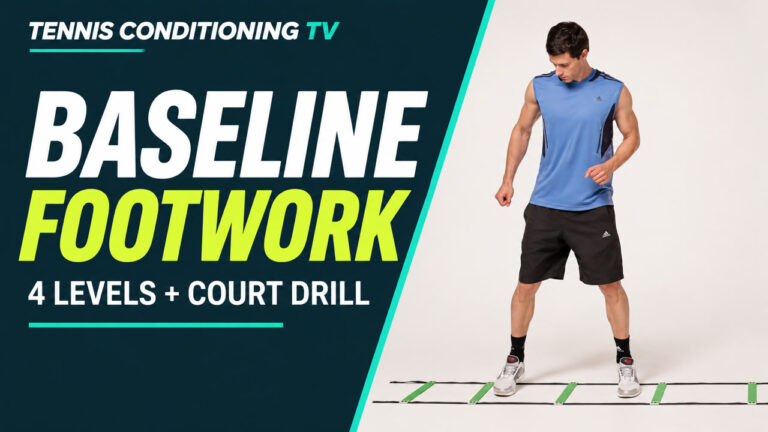
Fast Feet for Tennis: 4 Ladder Progressions Explained
Video Lesson · Philipp Halfmann, M.S. Exercise & Sports Science
Learn the Fast Feet contact pattern, then maintain it as the racquet and visual demands change. This six-minute coaching lesson follows the book’s four levels and explains how to assess their application in tennis practice.
Player not loading? Open This Lesson Video Directly. The full transcript is available below.
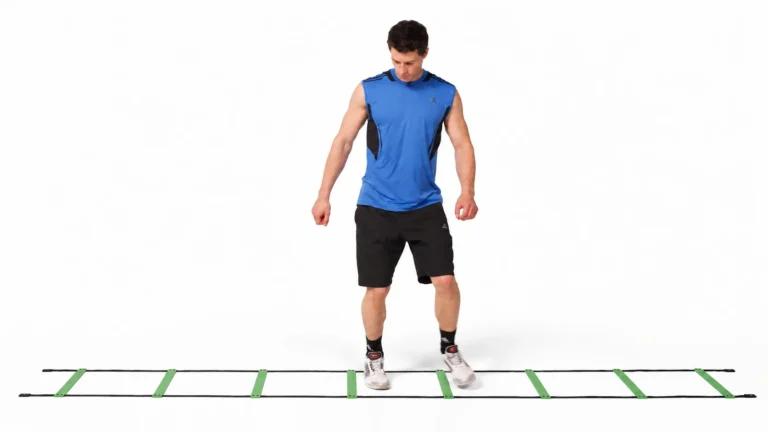
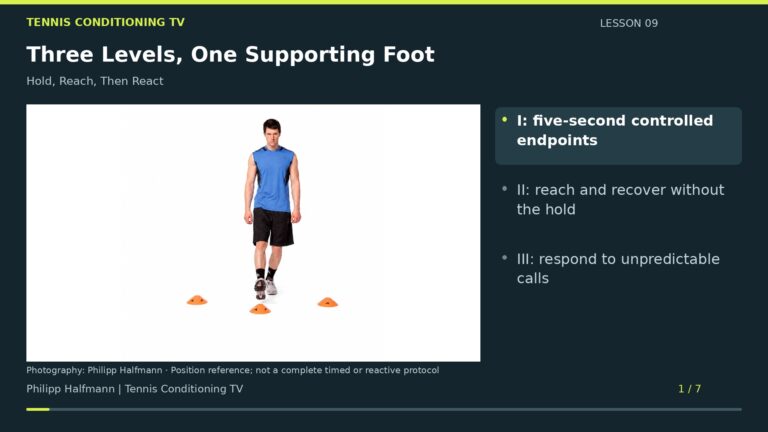
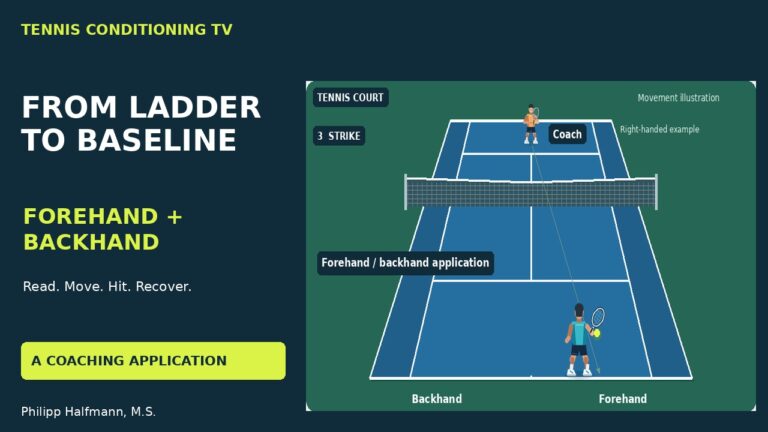
Real footage demonstrates Level I. Later levels use labelled teaching graphics; court animations illustrate coaching applications. Narration uses a synthetic catalogue voice.
The Four Progression Levels
- Level I: Learn the prescribed foot pattern without a racquet, looking down for feedback.
- Level II: Add the racquet while continuing to look down.
- Level III: Retain the racquet and foot pattern while looking forward.
- Level IV: Maintain the pattern and racquet position while visually tracking an opponent ahead.
Increase the demand when the prescribed contacts remain repeatable. If the route or contact sequence breaks down, reduce the pace or return to the previous level.
Connect The Pattern To Tennis
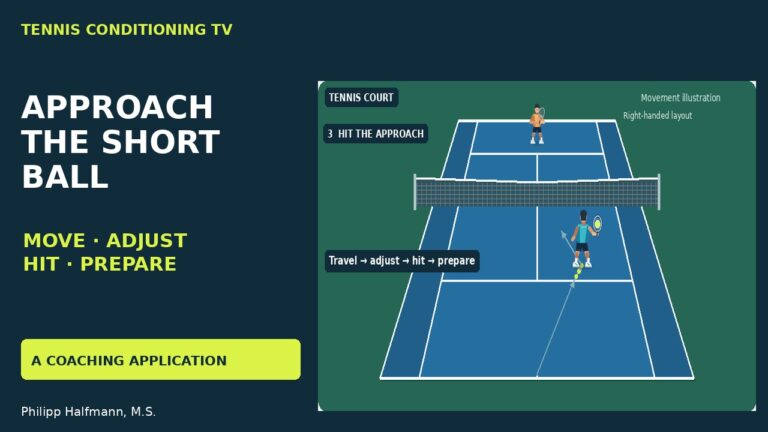
Have the coach feed a reachable ball that requires a short forward approach. The player reads the feed, moves toward the ball, uses final adjustment contacts to organize spacing, plays the stroke and recovers. Choose approach steps for the distance involved; do not use tiny ladder contacts as a prescription for covering the entire court. Assess arrival, balance, spacing and the shot outcome.
The purpose is to maintain useful movement while attention follows information beyond the feet. The on-court drill adds the ball, spacing and stroke timing that a prescribed ladder route does not contain. Faster ladder completion alone does not establish improved match performance.
Lesson Chapters
- 00:00 — See the four levels first
- 00:45 — Why practise this for tennis?
- 01:51 — I · Establish the foot pattern
- 02:44 — II · Add the racquet; gaze stays down
- 03:32 — III · Keep the racquet; look forward
- 04:30 — IV · Keep the pattern; track ahead
- 05:27 — Choose the level you can observe
Read The Full Lesson Transcript
See the four levels first
Here are the four Fast Feet levels in the book’s order. One: no racquet, looking down. Two: add the racquet, still looking down. Three: keep the racquet and look forward. Four: keep the racquet and track an opponent ahead. The foot pattern stays the same. A beginner uses downward gaze to learn that pattern through visual feedback. Later, the player maintains it while visual attention moves beyond the feet. On court, that attention needs to follow the opponent and ball while the feet organise movement and spacing for the stroke. The aim is preparation for better tennis performance. Let’s connect that aim to the movement before explaining each level.
Why practise this for tennis?
Think about arriving near a ball and making smaller adjustment steps to organise your spacing before the stroke. Fast Feet provides a defined setting for practising a short, repeated contact rhythm. Looking down helps a beginner learn that pattern through visual feedback. The later levels ask the player to retain the contacts while holding a racquet and directing attention forward, then tracking an opponent. That brings the practice conditions closer to some of the demands of tennis. The next application is to combine movement with reading a real ball and making a stroke on court. The ball determines the timing and location, and the player needs suitable spacing to hit. Fast Feet one through four does not include a ball feed or a stroke. Its role here is to prepare a movement pattern under increasing equipment and visual demands, then check the application in a separate tennis task. A quicker ladder pass alone does not establish better match performance.
I · Establish the foot pattern
Level one is exercise seven point twenty-two. Watch the two successive contacts in each ladder square. One foot enters, then the other. Keep that stepping order as you move forward; a simultaneous two-foot jump would change the task. This footage shows level one: no racquet, with the gaze directed toward the feet. For a beginner learning this pattern, that view provides feedback about the foot placements. Watch the replay at half speed and follow the contacts in a single square. Then return to normal speed to see the rhythm of the whole pass. The clip shows one lead-foot pass. Complete a separate pass with the other foot leading. Before adding another demand, check that the player understands the intended sequence and can repeat it at the selected pace.
II · Add the racquet; gaze stays down
Level two is exercise seven point twenty-three. Do the same movement pattern while holding a racquet in both hands in the ready position. Keep looking down at the foot placements. The racquet is the change at this level; looking forward comes next. The demonstration on screen remains level one, so use it to reference the footwork, not the racquet position. The progression card tells you what to add. Watch whether holding the racquet changes the contact sequence or causes missed squares. If it does, reduce the pace and re-establish the pattern under that condition. Keep the comparison clear: the contacts and gaze instruction remain the same while the equipment demand changes.
III · Keep the racquet; look forward
Level three is exercise seven point twenty-four. Retain the two-hand racquet position and the same two contacts in every square. Now direct the gaze forward. That is the new instruction. The purpose is to maintain the learned foot pattern while visual attention is no longer directed at the feet. The clip still shows the downward-gaze base version; the forward-gaze requirement is explained here rather than demonstrated. When you practise level three, check whether the player can retain the contact sequence without continually looking back down. If the pattern becomes confused, simplify the pace or return to the preceding condition. Do not change the route simply to finish the ladder. A quicker pass using a different sequence would not show that the original pattern has been maintained with the new visual demand.
IV · Keep the pattern; track ahead
Level four is exercise seven point twenty-five. Keep the ladder route and the racquet position, and visually track an opponent ahead. The purpose of the earlier practice becomes clearer here: maintain the foot pattern while using vision to follow someone in front of you. On court, the opponent and ball provide information for the next movement and stroke. This level introduces an opponent-tracking task while retaining a prescribed ladder route. The moving marker explains that visual task; it is a schematic, not footage of level four. Tracking does not change the prescribed route, and this drill family does not yet include hitting a ball. Follow it with a separate on-court task that combines movement, ball reading, spacing and a stroke. Judge that tennis task by what the player does with the ball, as well as how the feet move.
Choose the level you can observe
The goal is useful tennis movement, not a better-looking ladder pass. Use the four-level map to build toward that goal. First learn the foot pattern without a racquet, using downward gaze for feedback. Add the racquet while retaining that gaze. Keep the racquet and look forward. Then track an opponent ahead while maintaining the route. Observe whether the original contacts remain repeatable as the demands change. Next, combine movement with tracking the ball and making a stroke in a separate on-court task. Check the spacing, timing and shot outcome there. The ladder gives you a controlled practice setting; the court is where you assess the intended application.
Continue Your Footwork Practice
Next lesson: apply forward movement in a short-ball approach drill.
Open the exercise instructions and photographs · Watch the companion footwork lesson
Read: Tennis Footwork Beyond Ladder Drills · Browse Training Articles
Advanced Concepts of Strength & Conditioning for Tennis — Second Edition
Subscribe to Tennis Conditioning TV on YouTube for further coaching lessons.