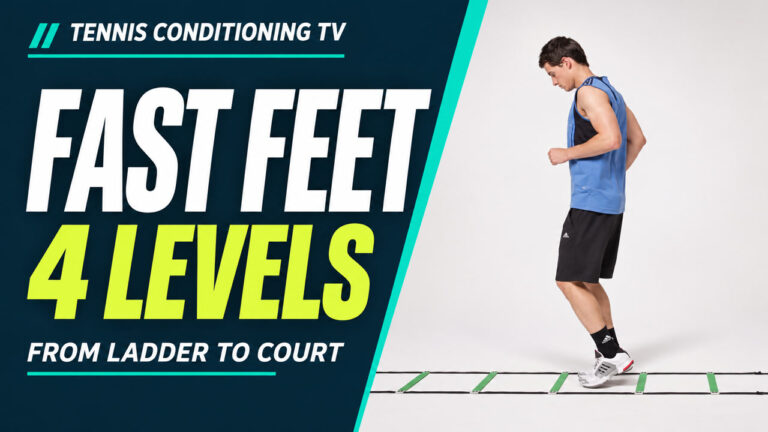
Lateral Fast Feet for Tennis: From Ladder to Baseline
Video Lesson · Philipp Halfmann, M.S. Exercise & Sports Science
Connect lateral ladder practice to short sideways repositioning along the baseline. This seven-minute lesson explains the four book progressions and a separate coach-fed forehand–backhand drill.
Player not loading? Open This Lesson Video Directly. The full transcript is available below.
Real footage demonstrates Level I. Later levels use labelled teaching graphics; court animations illustrate coaching applications. Narration uses a synthetic catalogue voice.
The Four Progression Levels
- Level I: Learn the prescribed foot pattern without a racquet, looking down for feedback.
- Level II: Add the racquet while continuing to look down.
- Level III: Retain the racquet and foot pattern while looking forward.
- Level IV: Maintain the pattern and racquet position while visually tracking an opponent ahead.
Increase the demand when the prescribed contacts remain repeatable. If the route or contact sequence breaks down, reduce the pace or return to the previous level.
Connect The Pattern To Tennis
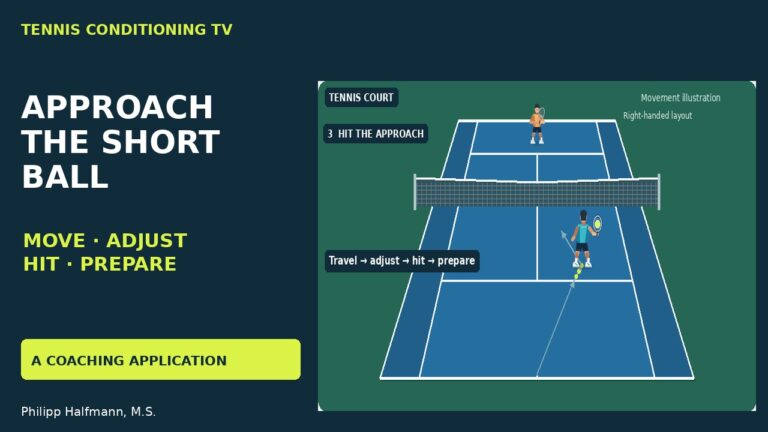
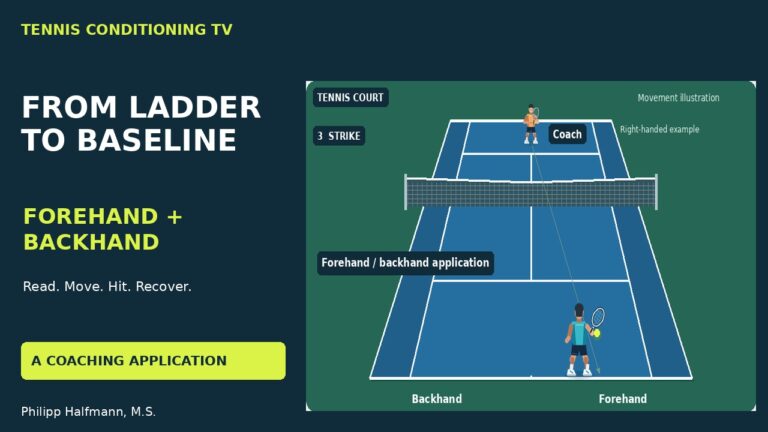
Start the player near the centre of the baseline. The coach feeds manageable balls alternately toward the forehand and backhand sides. The player moves laterally, adjusts spacing, sets up and hits each groundstroke, then recovers for the next feed. Keep the feeds close enough for the intended lateral pattern. A wider ball may require running or crossover steps instead. Increase feed variation only while the player can read the ball and organize the stroke.
The purpose is to maintain useful movement while attention follows information beyond the feet. The on-court drill adds the ball, spacing and stroke timing that a prescribed ladder route does not contain. Faster ladder completion alone does not establish improved match performance.
Lesson Chapters
- 00:00 — Why lateral fast feet?
- 00:44 — Connect the pattern to baseline movement
- 01:46 — I · Learn the sideways contact rhythm
- 02:40 — II · Add the racquet; keep gaze down
- 03:31 — III · Look forward across the ladder
- 04:21 — IV · Track the opponent ahead
- 05:14 — Apply it: coach-fed forehand and backhand
- 06:15 — Assess the tennis outcome
Read The Full Lesson Transcript
Why lateral fast feet?
During a baseline groundstroke exchange, a player may need to reposition sideways while staying oriented toward the opposite court. Lateral Fast Feet gives us a controlled setting to practise a short, repeated sideways contact rhythm. Here are the four levels in the book's order. One: no racquet, looking down. Two: add the racquet and keep looking down. Three: retain the racquet and look forward across the ladder. Four: retain the pattern and racquet while tracking an opponent ahead. Then take the learned pattern onto the court and reinforce it in a tennis drill. We will finish with a coach-fed forehand and backhand example.
Connect the pattern to baseline movement
Imagine moving a short distance toward the forehand side, organising your spacing, setting up the stroke, and then repositioning toward the backhand side. That is one application for practising quick lateral contacts. The ladder isolates the rhythm and direction of the stepping task. On court, the ball determines the required distance, timing and shot preparation. Efficient positioning can help the player arrive with suitable spacing and readiness for the stroke. That is the intended performance benefit, which we assess during actual tennis practice. A wide ball may require running or crossover steps instead of the small lateral pattern. Select the movement for the situation rather than forcing the same steps across every distance. Use the ladder to establish the pattern, its progressions to add equipment and visual demands, and a court drill to check how the player uses it with the ball.
I · Learn the sideways contact rhythm
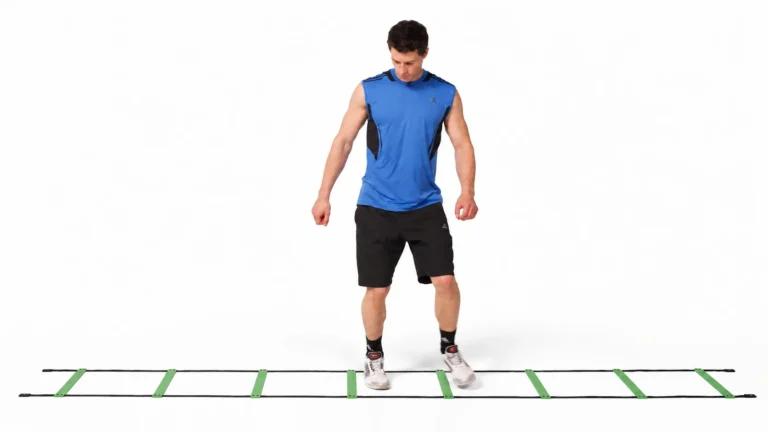
Level one is exercise seven point thirty. Face across the ladder and travel sideways along it without a racquet, looking toward the feet. When travelling right, place the right foot and then the left foot in each square. When travelling left, place the left foot and then the right foot in each square. Each square receives two separate contacts. The footage shows both directions. Watch the full pass, then the half-speed replay. Check that the athlete keeps a sideways orientation instead of turning to face along the ladder. Looking down provides visual feedback while a beginner learns the pattern. Practise both directions and increase cadence only while the selected contact order remains repeatable. The starting task is to learn this specific sequence clearly.
II · Add the racquet; keep gaze down
Level two is exercise seven point thirty-one. Keep the same lateral route and contact order while holding a racquet in both hands in the ready position. Retain downward gaze. The racquet is the added demand here; looking forward comes at the next level. The clip on screen remains the no-racquet level-one reference. Use it to review the contacts, then apply the racquet instruction during practice. Observe whether the player maintains the right-left rhythm when travelling right and the left-right rhythm when travelling left. Reduce the pace if the equipment change disrupts the sequence. This comparison gives you a specific coaching question: can the player retain the learned lateral pattern while carrying the racquet as prescribed?
III · Look forward across the ladder
Level three is exercise seven point thirty-two. Keep the racquet in both hands and retain the contact order. Now look forward across the ladder, in the direction the athlete is facing. Do not turn to look along the direction of sideways travel. The purpose is to maintain the learned foot pattern while visual attention is no longer directed toward the feet. That matters for the later tennis task, where the player needs information from the court and ball while moving. The footage still demonstrates the downward-gaze base level; this forward-gaze requirement is an instruction to apply, not a condition shown in the clip. Observe whether the original pattern survives the changed visual demand before adding the next one.
IV · Track the opponent ahead
Level four is exercise seven point thirty-three. Retain the lateral stepping pattern and the racquet while visually tracking an opponent ahead of the athlete's facing direction. Practise travel in both directions. The moving marker illustrates the visual task; it is not footage of level four. The progression moves from looking at the foot placements toward maintaining the pattern while attending to someone across the court. The prescribed ladder route remains fixed. A tennis rally also requires reading the ball and adapting the movement to its flight. Those demands belong in the next application. Once the player can perform the selected progression as intended, move into a court drill that reinforces the lateral pattern while setting up and hitting actual shots.
Apply it: coach-fed forehand and backhand
Here is the separate on-court application. The athlete starts at the baseline and the coach feeds a ball toward the forehand side. Set the feed distance and pace so that a short lateral movement is appropriate. The athlete moves sideways with quick contacts, organises the spacing, sets up and hits the forehand. The coach then feeds toward the backhand side. The athlete repositions laterally, sets up and hits the backhand. Continue with controlled feeds that allow the intended movement and shot preparation. This animation is an illustrative drill layout, not filmed player performance. The exact two-contacts-per-ladder-square rule does not carry onto the court. The ball and stroke determine the adjustments. If the feed sends the player farther or leaves less time, allow the appropriate running or crossover steps rather than forcing the ladder pattern.
Assess the tennis outcome
In that forehand-backhand drill, observe more than how quickly the feet move. Is the athlete using the lateral pattern where it fits the distance? Is there suitable spacing and time to organise the stroke? Can the player track the ball, make contact and reposition for the next feed? Adjust the feed and pace to keep the intended movement task clear. The book's four ladder progressions prepare the pattern under increasing equipment and visual demands. The coach-fed court drill reinforces its use while hitting the ball. Better performance is the goal; the tennis task is where you check whether the work is helping. Learn the pattern, progress it in the book's order, then apply and assess it on court.
Continue Your Footwork Practice
Next lesson: coach the forehand–backhand baseline drill.
Open the exercise instructions and photographs · Watch the companion footwork lesson
Read: Tennis Footwork Beyond Ladder Drills · Browse Training Articles
Advanced Concepts of Strength & Conditioning for Tennis — Second Edition
Subscribe to Tennis Conditioning TV on YouTube for further coaching lessons.