Loaded Single-Leg Tuck Jumps | Exercises 7.136–7.144
Book exercises 7.136–7.144 from Advanced Concepts of Strength & Conditioning for Tennis. Low, mid and high describe the airborne working-knee position. I–III describe the visual and ball-handling tasks within each level.
Photographic Movement References
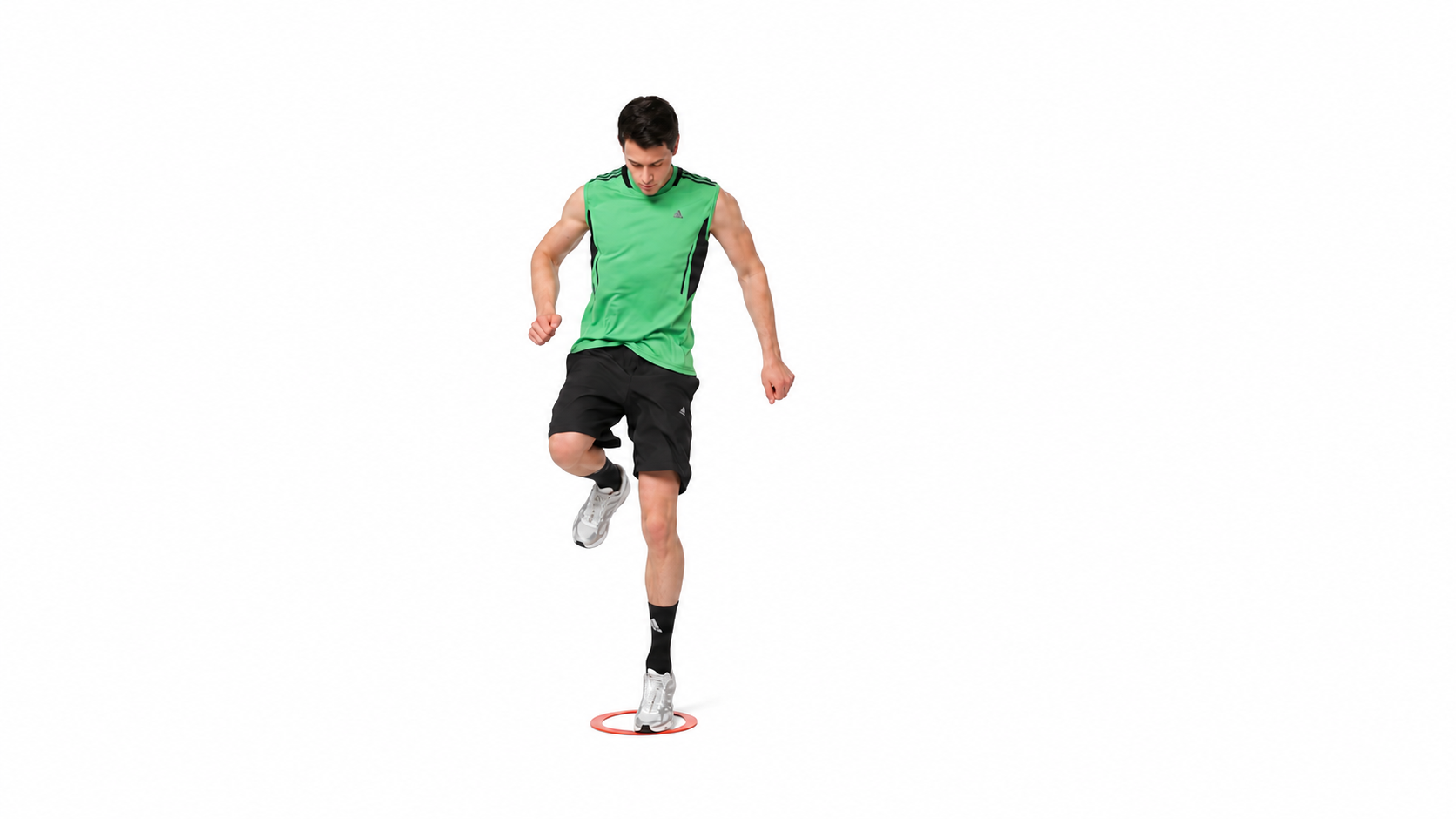
The photographs below show the single-leg contact pattern without ankle weights. Use them for the working-leg and tuck positions, then apply the loaded setup and progression instructions. They do not depict the loaded variations or the ball exchange.
Ankle-Weight Equipment Reference

Setup And Execution
Same-Leg Takeoff and Landing
Secure the ankle weights and place one ring on a flat surface. Stand inside it on one working leg, with the other foot clear of the ground. Jump vertically from the working foot, tuck its knee to the selected level, then land on that same foot inside the ring. Keep the free foot off the ground through takeoff and landing. Complete the sequence on one leg before switching and repeating on the other. The single-leg flight and landing references in 7.213–7.221 illustrate this contact pattern without external load.
Low — 7.136–7.138: working knee below hip height. Mid — 7.139–7.141: working knee at hip height. High — 7.142–7.144: working knee above hip height. Use the airborne position of the working knee to judge the level; a higher free knee does not establish the required tuck.
At each level, I uses downward gaze toward the ground and II uses forward gaze, both with the ring. III adds a coach-fed tennis ball with forward gaze; catch and return the ball during the jump sequence. Rings are omitted from III’s equipment list. Retain the same ground position and working-leg landing, and repeat with the other leg. Switch legs between sequences rather than alternating feet at successive contacts.
Prepare each single-leg level with its corresponding loaded bilateral tuck pattern. Add the forward-gaze task only while the same-leg landing remains repeatable, then add the ball exchange. Regress the load, tuck level or visual task when the athlete drifts, touches down with the free foot or loses balance while catching. Evaluate both sides separately; successful repetitions on one leg do not establish control on the other.
Progression Matrix — 7.136–7.144
| Reference | Tuck Level | Visual Or Ball Task | Landing Targets |
|---|---|---|---|
| 7.136 | Low: working knee below hip | I: downward gaze | One ring; same working foot at takeoff and landing |
| 7.137 | Low: working knee below hip | II: forward gaze | One ring; same working foot at takeoff and landing |
| 7.138 | Low: working knee below hip | III: forward gaze; catch and return the coach-fed ball | No ring specified; retain the same working-leg landing position |
| 7.139 | Mid: working knee at hip | I: downward gaze | One ring; same working foot at takeoff and landing |
| 7.140 | Mid: working knee at hip | II: forward gaze | One ring; same working foot at takeoff and landing |
| 7.141 | Mid: working knee at hip | III: forward gaze; catch and return the coach-fed ball | No ring specified; retain the same working-leg landing position |
| 7.142 | High: working knee above hip | I: downward gaze | One ring; same working foot at takeoff and landing |
| 7.143 | High: working knee above hip | II: forward gaze | One ring; same working foot at takeoff and landing |
| 7.144 | High: working knee above hip | III: forward gaze; catch and return the coach-fed ball | No ring specified; retain the same working-leg landing position |
Load And Progression Decisions
Record the ankle-weight mass per ankle and the combined mass. The original 5–10 lb equipment range does not clearly distinguish per-ankle from total mass; do not treat it as an automatic starting-load prescription. Secure the cuffs so they do not shift. Keep the selected foot contacts and knee-height task repeatable before increasing load, changing gaze or adding the ball exchange.
The vertical family uses no cone. Complete the repetitions on one working leg, then repeat on the other; do not replace the same-leg takeoff and landing with alternating-foot contacts. A high free knee does not establish a high working-knee tuck.
Technique References Without Added Load
The following existing photographs illustrate the contact pattern without ankle weights. Apply the written loaded setup above; the pictures do not document the loaded task.