
Loaded Bilateral Tuck Jumps For Tennis | 7.127–7.135
Book family 7.127–7.135 from Advanced Concepts of Strength & Conditioning for Tennis.
Video References And Limits
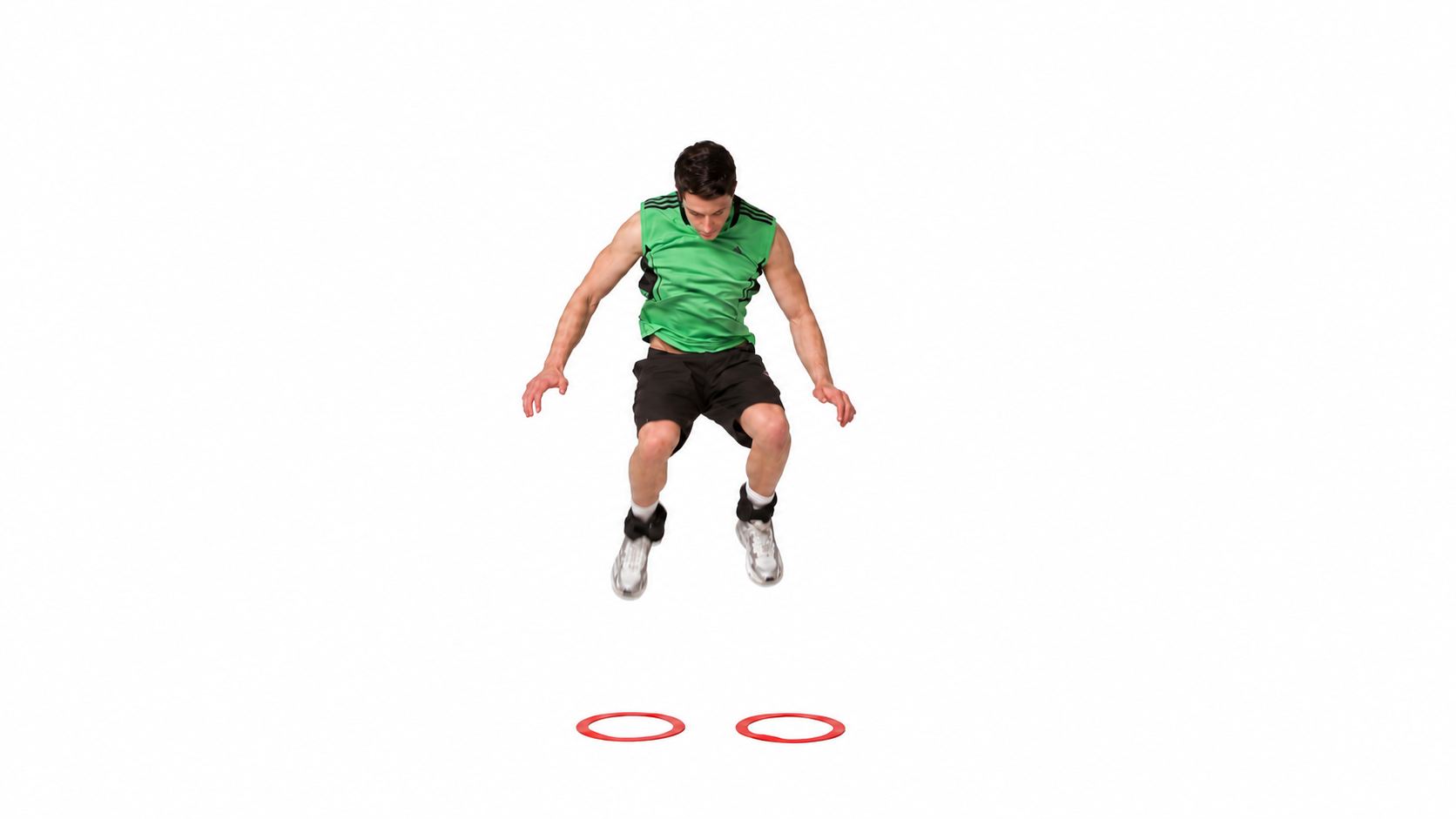
The clip shows ankle weights, two rings, bilateral takeoffs and landings, and downward gaze. It is a movement reference; it does not establish all three knee-height targets or show the forward-gaze and ball-exchange stages.
Loaded Bilateral Tuck-Jump Movement Reference
Setup And Execution
Movement And Loading
Secure the ankle weights and stand with the feet under the shoulders, one foot in each of two rings. Jump vertically with both feet together. Draw both knees to the prescribed level while airborne, then return the feet beneath the body and land together in the same rings. Keep the contacts in place instead of drifting forward or backward. Record the load and whether its stated mass applies to each ankle or the pair; the original 5–10 lb equipment entry does not resolve that distinction.
Low — 7.127–7.129: keep the knees below hip height. Mid — 7.130–7.132: bring the knees to hip height. High — 7.133–7.135: bring the knees above hip height toward the chest. The level describes the tuck, not a required increase in flight height. For the high tuck, emphasize quick leg recovery rather than pursuing maximum jump height.
Within each level, I uses downward gaze toward the feet and II uses forward gaze, retaining both rings. III keeps forward gaze and adds a tennis ball thrown by the coach during the jumps: catch it and return it while maintaining the jump location. The source omits rings from III’s equipment list. Keep the same controlled ground position even when the visible ring targets are removed. Change the tuck level and visual task separately so the coach can identify which demand disrupts the movement.
The existing photograph and video supply the bilateral movement reference. Apply the specified knee-height target and gaze for the selected variation; the clip does not demonstrate the coach-fed ball stage. Reduce the demand when landing position, simultaneous foot contacts or the prescribed tuck cannot be maintained.
Record the actual mass on each ankle and the total added load. The original 5–10 lb range does not specify per-ankle versus pair mass. Reduce load when it disrupts the prescribed takeoff, contact position or return sequence.
Technique Photographs
Book Progressions
7.127 — Low-Level Loaded Bilateral Tuck Jump I
Keep the knees below hip height. Take off and land on both feet together, retaining the same ground location. Look down toward the feet and retain the ring targets.
7.128 — Low-Level Loaded Bilateral Tuck Jump II
Keep the knees below hip height. Take off and land on both feet together, retaining the same ground location. Look forward and retain the ring targets.
7.129 — Low-Level Loaded Bilateral Tuck Jump III
Keep the knees below hip height. Take off and land on both feet together, retaining the same ground location. Look forward; catch and return a coach-fed tennis ball during the jumps. Rings are omitted from this stage’s equipment list; retain the intended landing locations.
7.130 — Mid-Level Loaded Bilateral Tuck Jump I
Keep the knees at hip height. Take off and land on both feet together, retaining the same ground location. Look down toward the feet and retain the ring targets.
7.131 — Mid-Level Loaded Bilateral Tuck Jump II
Keep the knees at hip height. Take off and land on both feet together, retaining the same ground location. Look forward and retain the ring targets.
7.132 — Mid-Level Loaded Bilateral Tuck Jump III
Keep the knees at hip height. Take off and land on both feet together, retaining the same ground location. Look forward; catch and return a coach-fed tennis ball during the jumps. Rings are omitted from this stage’s equipment list; retain the intended landing locations.
7.133 — High-Level Loaded Bilateral Tuck Jump I
Keep the knees above hip height. Take off and land on both feet together, retaining the same ground location. Look down toward the feet and retain the ring targets.
7.134 — High-Level Loaded Bilateral Tuck Jump II
Keep the knees above hip height. Take off and land on both feet together, retaining the same ground location. Look forward and retain the ring targets.
7.135 — High-Level Loaded Bilateral Tuck Jump III
Keep the knees above hip height. Take off and land on both feet together, retaining the same ground location. Look forward; catch and return a coach-fed tennis ball during the jumps. Rings are omitted from this stage’s equipment list; retain the intended landing locations.
Related Exercise Families
- Loaded Lateral Box Jump Rebounds — 7.92–7.95
- Loaded Single-Leg Lateral Tuck Jumps — 7.154–7.162
- Mid-Level Abductor And Adductor Box Rebounds — 7.96–7.100
- Loaded Forward And Backward Box Jump Rebounds — 7.88–7.91
Advanced Concepts of Strength & Conditioning for Tennis · Tennis Conditioning Workouts · Exercise Library