Lateral Fast Feet To Ball-Drop & React I–IV | Exercises 7.58–7.61
Book exercises 7.58–7.61 from Advanced Concepts of Strength & Conditioning for Tennis.
Illustrated Exercise Instructions
Use the photographs and diagrams alongside the written instructions for the selected stance, equipment, contacts, gaze and progression.
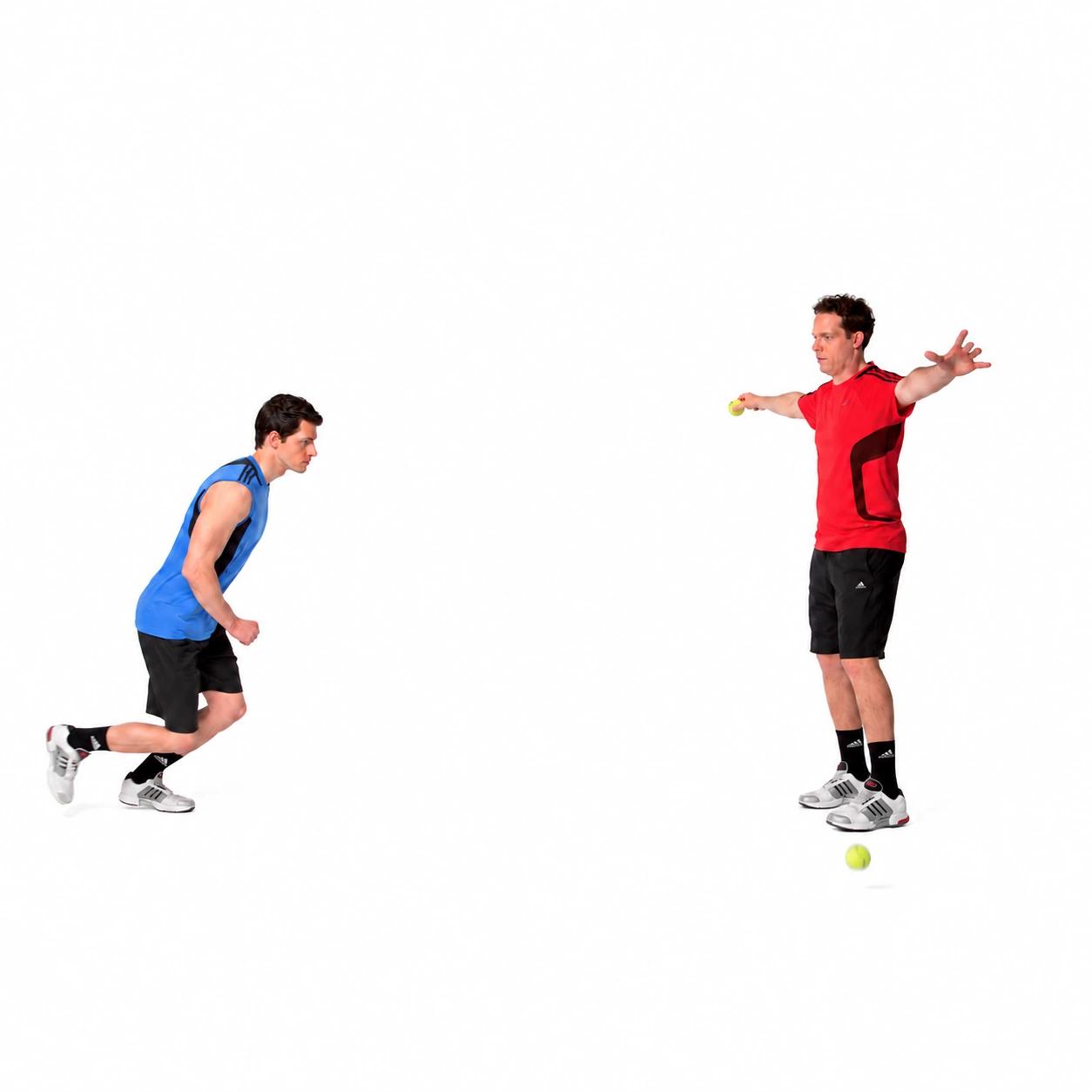
Place the short ladder behind the center of the baseline and face the
net while moving laterally. In I–III, the coach stands at the service T
with a ball in each hand and arms raised to shoulder/ear height. Keep
moving until the audible cue (I–II) or visible release (III), then
accelerate to the ball. IV moves the coach to the opposite baseline and
adds a four-cone return-shot target; aim for more than 60% successful
shots. Preparation: matching Lateral Fast Feet (7.30–7.33) and Jump-Over
Fast Feet (7.26–7.29) stages.
Original Photographs and Court Setups
Progressions
- ID
- 7.58
- Stage / Variation
- LATERAL FAST FEET TO BALL-DROP & REACT (I)
- What changes
- Respond to an audible signal during downward-gaze ladder movement
and catch the dropped ball by hand before its second bounce.
- ID
- 7.59
- Stage / Variation
- LATERAL FAST FEET TO BALL-DROP & REACT (II)
- What changes
- Retain the audible cue and downward-gaze ladder movement while
carrying a racquet. Intercept the dropped ball with the racquet before
its second bounce.
- ID
- 7.60
- Stage / Variation
- LATERAL FAST FEET TO BALL-DROP & REACT (III)
- What changes
- Look forward during the ladder movement, respond to the visible ball
release and hit the dropped ball before its second bounce.
- ID
- 7.61
- Stage / Variation
- LATERAL FAST FEET TO BALL-DROP & REACT (IV)
- What changes
- Track a coach on the opposite baseline, respond to a fed ball and
hit toward a marked target before the ball’s second bounce.
Related Training Resources
Compare related tasks in the training category and use the workout library for session context. Retain the selected level, equipment and execution conditions in the training record.
Related Exercise Families
- Lateral Fast Feet I For Tennis | Exercise 7.30
- Jump-Over Fast Feet I For Tennis | Exercise 7.26
- Ball-Drop & React Test For Tennis | 4.19
Use related pages for their stated tasks. A loaded variation, a firm-floor preparation or a separate test does not replace the setup prescribed here.
Photographs and Diagrams
The illustrations show the stated positions and routes. Follow the variation instructions for gaze, contacts and landing conditions.