
How This Test Informs Lifting
Relate the shoulder findings to an overhead-position check. The athlete needs shoulder flexibility that permits the bar to be supported above the head in the selected receiving position. Observe forward bar placement and compensating trunk movement when teaching overhead support.
Address the identified range or movement limitation, practise the component positions and reassess before advancing the sequence or resistance. The shoulder reach test describes a combined reaching task; use an overhead-position observation to judge the actual support required for the snatch.
Original reference 4.03 · Chapter 3 Assessment in the Second Edition
Record the combined hand-behind-back reach on both sides. This task does not isolate rotator cuff range of motion.
How To Perform The Test
- Stand upright and keep the head neutral, looking forward.
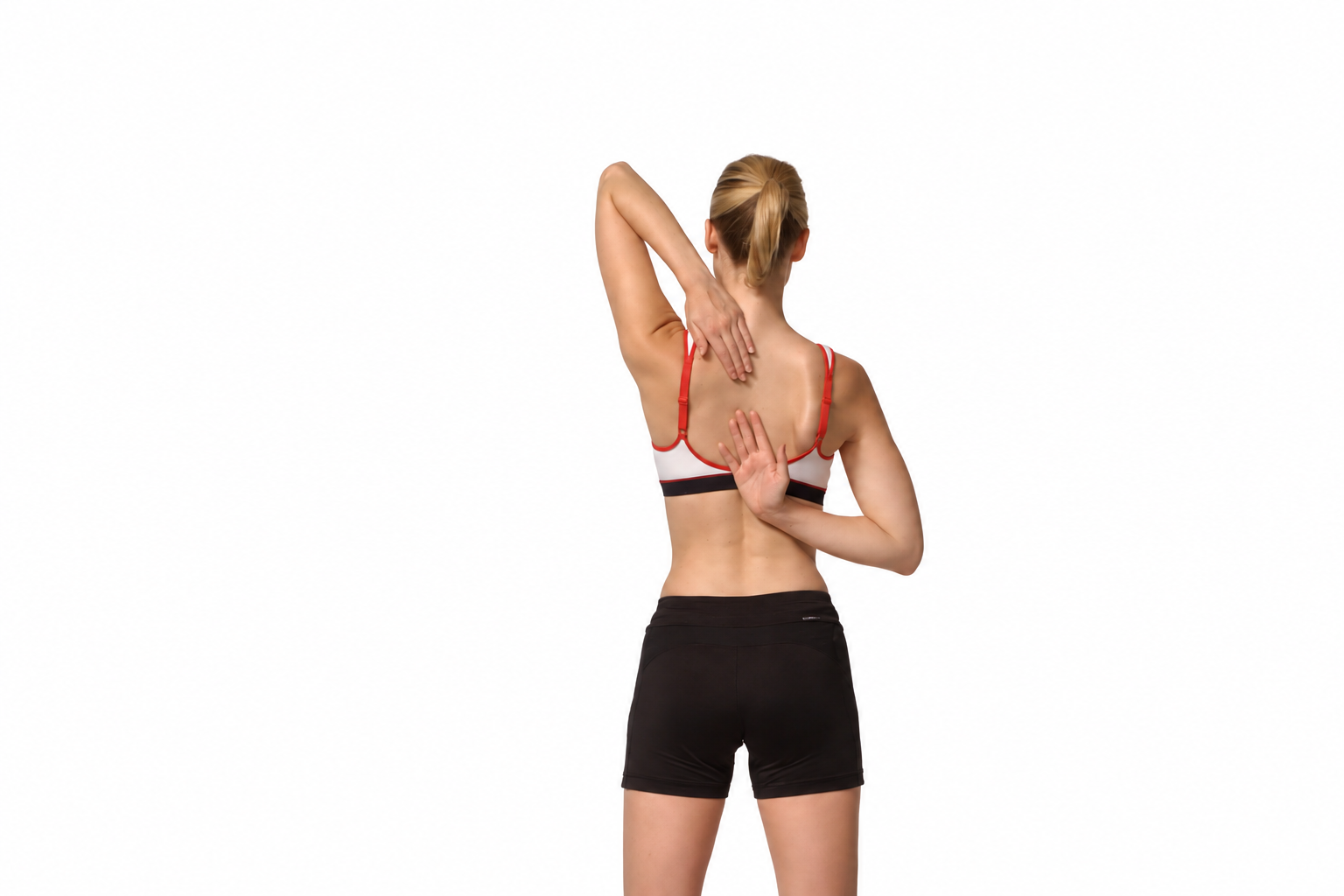
- Reach the right hand down the back from above the shoulder. Reach the left hand upward behind the back and try to connect the fingers.
- Record the reach for the upper arm, then switch sides and repeat with the left hand above the shoulder.
- If the hands do not connect, use a tape measure to record the distance between them. Compare the two sides.
The upper arm tests the externally rotated, abducted position; the lower arm reaches in internal rotation and adduction. Avoid twisting or forcing the reach to change the result.
Photographic Examples
These photographs show the same shoulder reach at different hand separations. They are illustrations of positions, not a substitute for observing finger contact and measuring the gap on each side.


Scoring From The Tennis Book
- Good: two or more fingers connect.
- Fair: the middle finger connects.
- Poor: no fingers touch; record the gap with a tape measure.
Score each shoulder separately. A photograph labeled “OK” cannot be assigned Fair if finger contact is not visible.
If Shoulder Mobility Is Limited
The book recommends Bar Rotator Cuff Stretch, Towel Shoulder Stretch, and Arm Circles to improve range of motion. Choose the exercise that addresses the observed limitation, then retest both shoulders using the same procedure.
Book Reference
4.03 Shoulder Mobility Test, original reference retained in Chapter 3 of the Second Edition of Advanced Concepts of Strength & Conditioning for Tennis. Return to Fitness Assessment.