
Unloaded Single-Leg Lateral Tuck Jumps For Tennis | 7.231–7.239
Book family 7.231–7.239 from Advanced Concepts of Strength & Conditioning for Tennis.
Video References And Limits
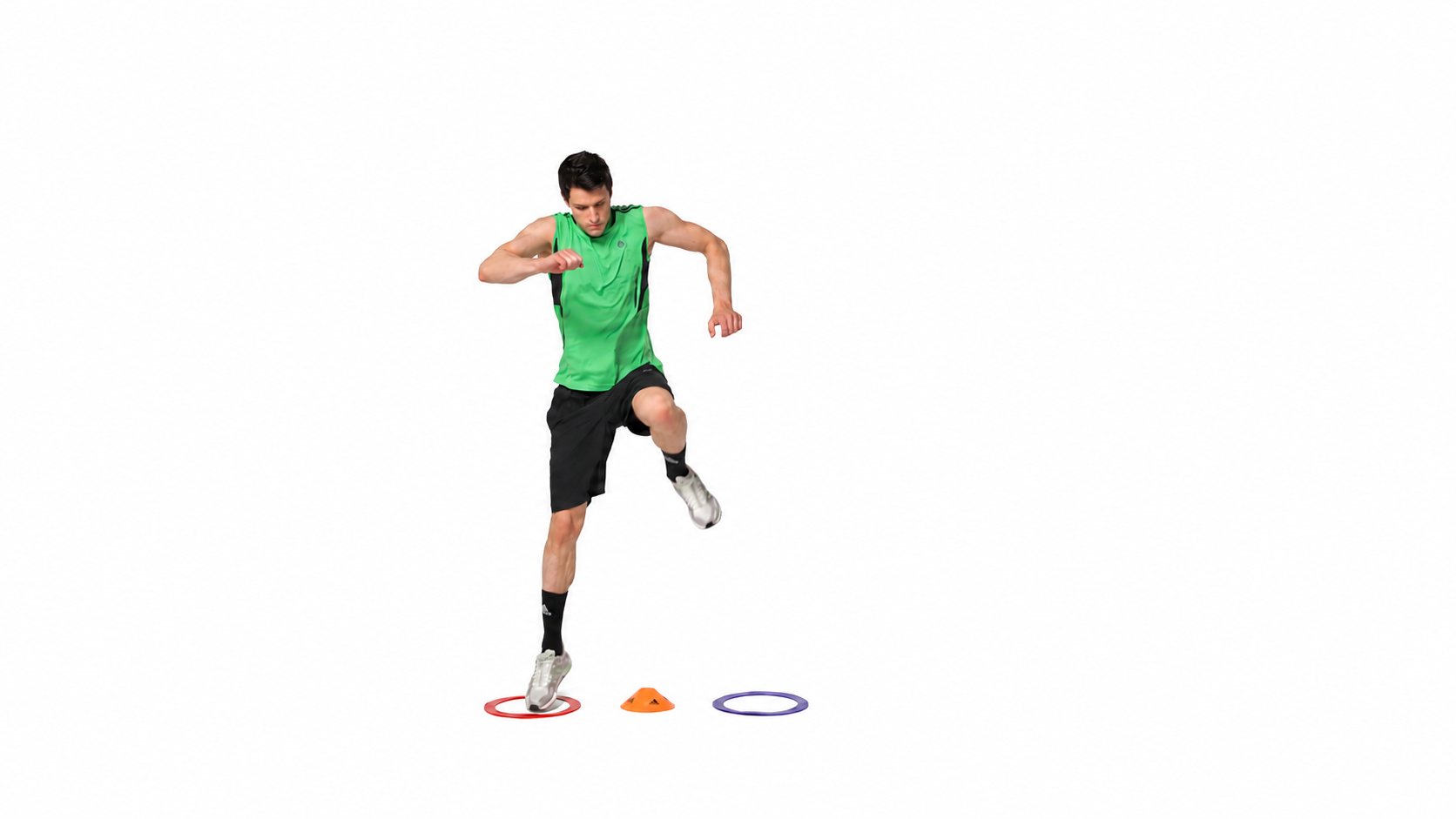
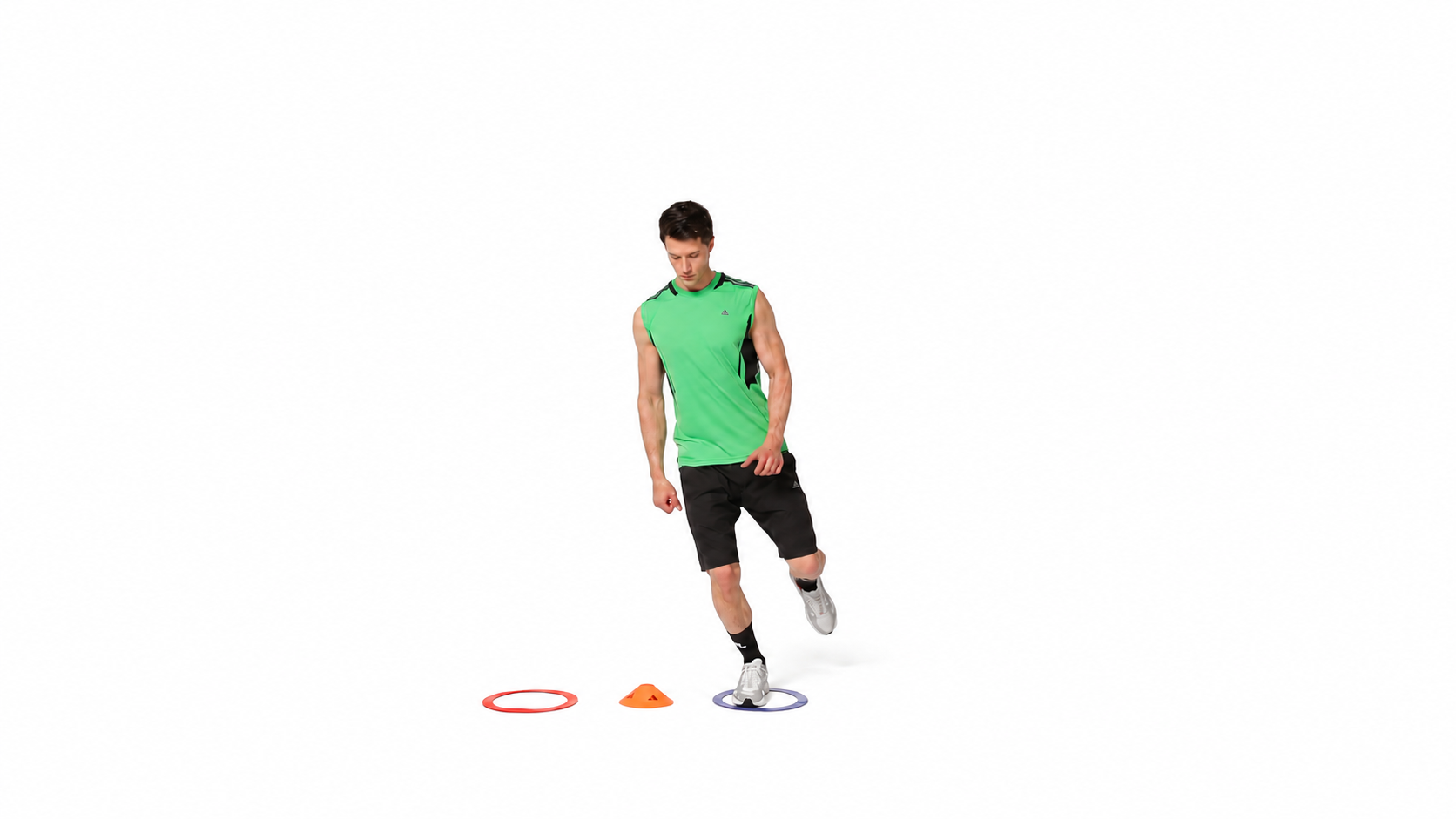
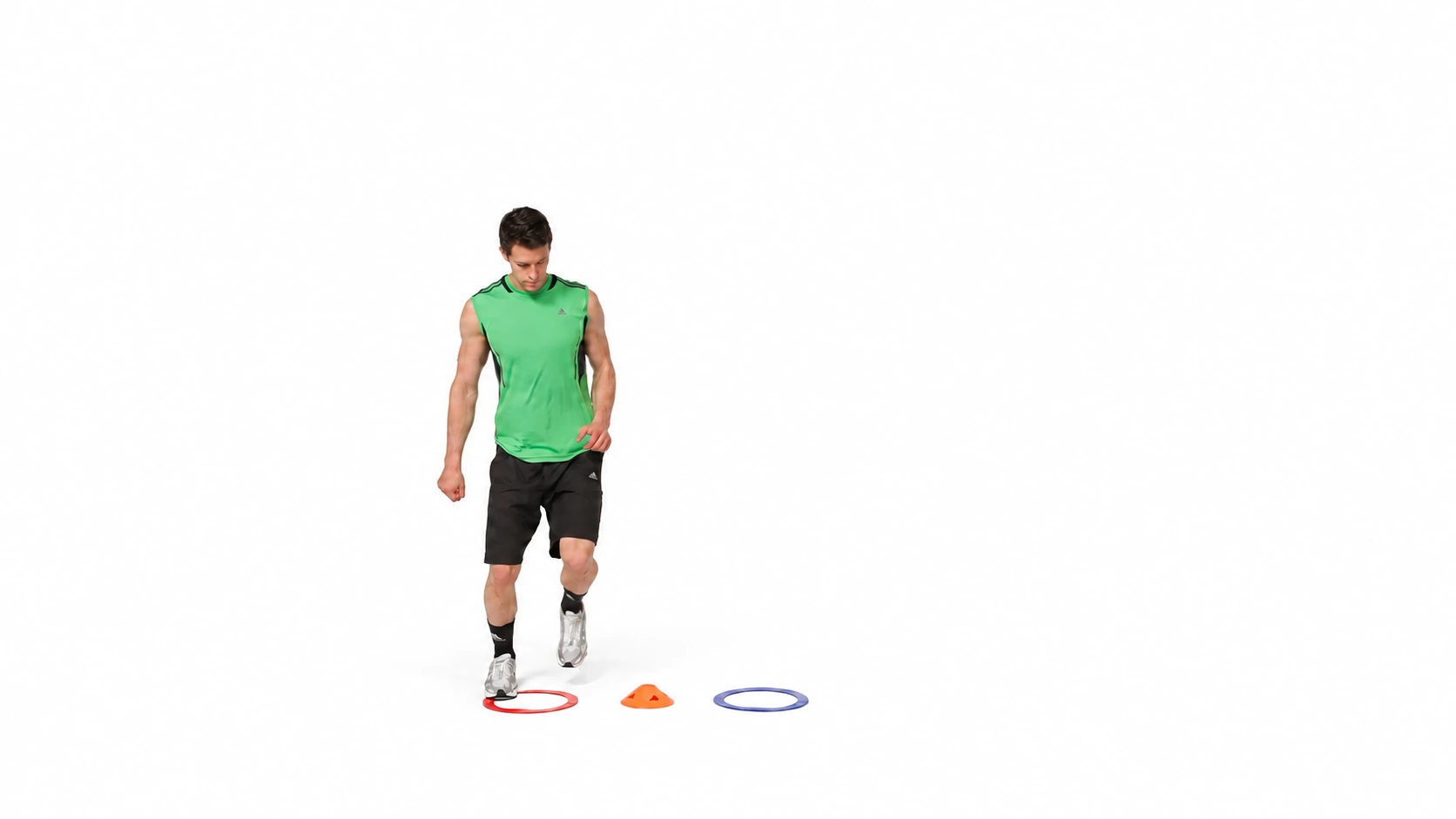
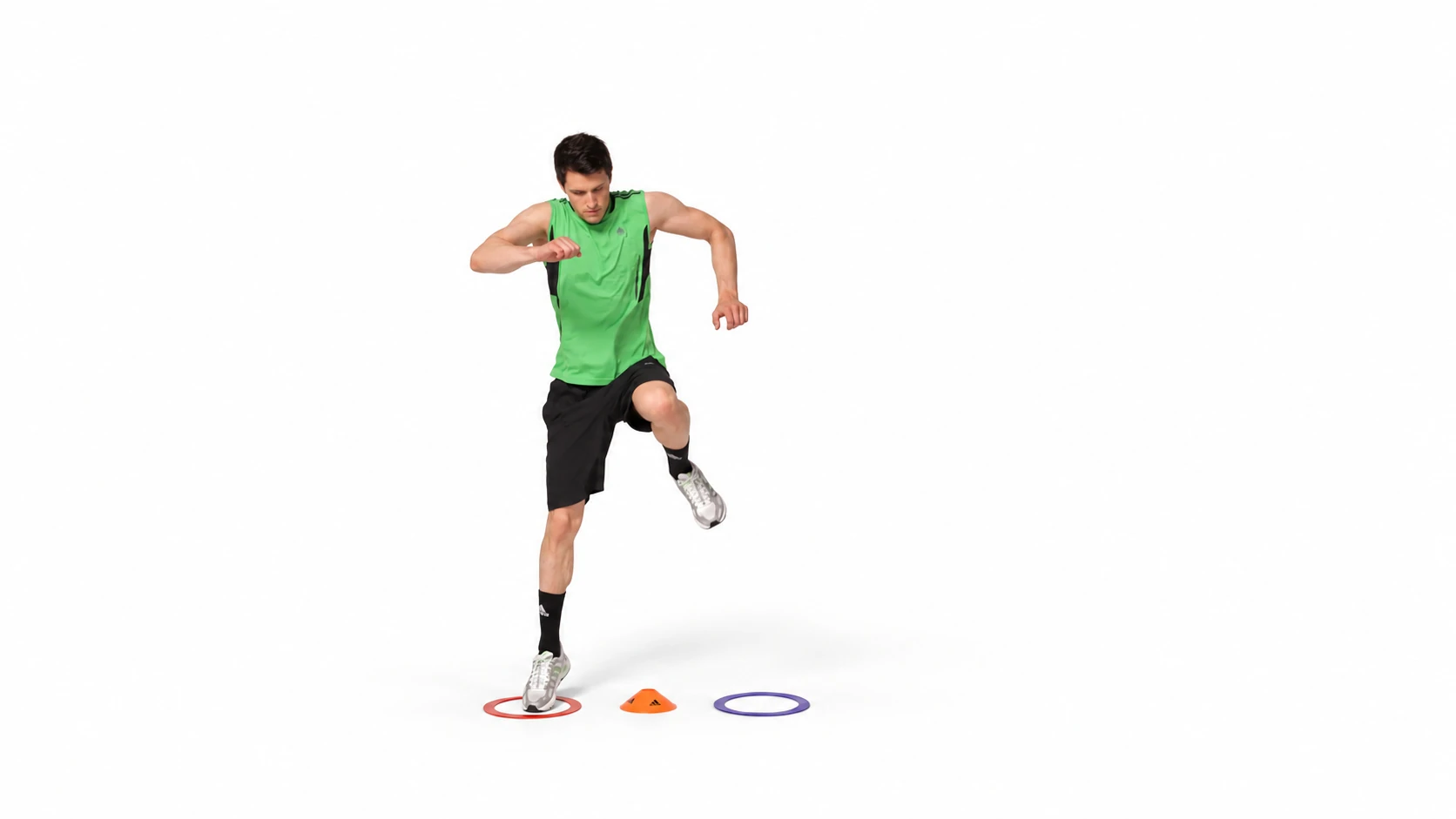
The clip shows one lateral crossing on the right leg with downward gaze. It ends after that landing and does not show the return crossing, the other leg or the ball task. The starting foot is beside rather than clearly inside the ring, so the clip illustrates jump mechanics rather than the complete prescribed setup. Follow the written ring placement, same-leg return and alternative starting positions.
Partial Mid-Level Right-Leg Movement Reference
Setup And Execution
Same-Leg Crossing And Return
Place two flat rings two shoulder-widths apart on a level surface, with the cone midway between them. Start in one ring on the leg closest to the cone, keeping the other foot clear of the floor. Jump laterally over the cone from that working leg and land on the same foot inside the opposite ring. Reverse direction and return to the starting ring on that same foot. Keep facing forward throughout; neither the outward crossing nor the return changes the working leg.
Practise both legs and both starting-leg positions. After a controlled sequence, reset and repeat with the leg that starts farthest from the cone. Repeat from the opposite side so each leg is practised in the near and far starting positions. The near/far instruction identifies the working leg at the start; its position relative to the cone changes after the crossing. Do not switch legs in midair or use the free foot to assist a landing.
Low — 7.231–7.233: 2-inch cone, working knee below hip height. Mid — 7.234–7.236: 4-inch cone, working knee at hip height. High — 7.237–7.239: 6-inch cone, working knee above hip height toward the chest. Judge the tuck from the working knee while airborne. Keep the free foot clear, raise the working knee for cone clearance and recover the working foot beneath the body before the same-leg landing.
Within each level, I uses downward gaze toward the feet and II uses forward gaze; both retain the two rings. III retains forward gaze and adds a coach-fed tennis ball to catch and return during the back-and-forth jumps. Use the cone and ball without rings, preserving the same landing locations and working leg. Retain the near and far starting-leg practice. The ball exchange does not turn the exercise into alternating-leg jumps.
Prepare with the corresponding in-place tuck level and controlled single-leg landings before linking the lateral round trip. Practise the outward and return crossings on each leg before adding forward gaze or ball handling. Reduce the demand if the free foot touches down, the working knee misses its target, the cone is clipped or an extra recovery step is needed. Finish with a stable same-leg landing before lowering the free foot. The linked mid-level clip illustrates one right-leg crossing; the text supplies the return route, other leg and alternative starts.
Technique Photographs
Book Progressions
7.231 — Single-Leg Low-Level Lateral Tuck Jump I
The exercise practices lateral jumps over a low cone with same-leg landings and the working knee below hip level. Athlete looks down toward the feet and lands in alternating ring targets.
7.232 — Single-Leg Low-Level Lateral Tuck Jump II
The exercise practices lateral jumps over a low cone with same-leg landings and the working knee below hip level. Athlete looks forward and lands in alternating ring targets.
7.233 — Single-Leg Low-Level Lateral Tuck Jump III
The exercise practices lateral jumps over a low cone with same-leg landings and the working knee below hip level. Athlete looks forward while catching and returning a tennis ball.
7.234 — Single-Leg Mid-Level Lateral Tuck Jump I
The exercise practices lateral jumps over a low cone with same-leg landings and the working knee at hip level. Athlete looks down toward the feet and lands in alternating ring targets.
7.235 — Single-Leg Mid-Level Lateral Tuck Jump II
The exercise practices lateral jumps over a low cone with same-leg landings and the working knee at hip level. Athlete looks forward and lands in alternating ring targets.
7.236 — Single-Leg Mid-Level Lateral Tuck Jump III
The exercise practices lateral jumps over a low cone with same-leg landings and the working knee at hip level. Athlete looks forward while catching and returning a tennis ball.
7.237 — Single-Leg High-Level Lateral Tuck Jump I
The exercise practices lateral jumps over a low cone with same-leg landings and the working knee above hip level. Athlete looks down toward the feet and lands in alternating ring targets.
7.238 — Single-Leg High-Level Lateral Tuck Jump II
The exercise practices lateral jumps over a low cone with same-leg landings and the working knee above hip level. Athlete looks forward and lands in alternating ring targets.
7.239 — Single-Leg High-Level Lateral Tuck Jump III
The exercise practices lateral jumps over a low cone with same-leg landings and the working knee above hip level. Athlete looks forward while catching and returning a tennis ball.
Compare Stages 1–3 within each level for the constraint progression; compare Low, Mid and High for the movement-level progression. Do not treat the entries as permission to advance automatically—execution quality and the training objective govern progression.
Adjust The Training Demand
Rehearse controlled crossings and landings before linking the round trip or adding the ball task. Reduce the level or visual demand when contact order, knee height or balance deteriorates. These families are unloaded; ankle weights change the task.
Related Exercise Families
Tennis Conditioning Workouts · Exercise Library
Advanced Concepts Of Strength & Conditioning For Tennis — Book Details