
Medicine Ball Trunk Twist Throw I–V For Tennis | 7.109–7.113
Book family 7.109–7.113 from Advanced Concepts of Strength & Conditioning for Tennis. Select the support, timing and return conditions for the intended progression.
Video References
The clips show the throwing actions on one side. The two-foot clip omits the prescribed rings. All three clips include bounced partner returns; the book’s rotational-throw task instead says not to catch the rebound and to retrieve the ball after it settles. Use the footage for the throw mechanics and support positions, and follow the written reset. Mirror the required side or support leg. IV–V’s alternating side-step and opposite-foot finishes are written progressions, not demonstrated sequences.
I: Two-Foot Movement Reference
II: Diagonal Lunge
III: Single-Leg Support
Setup And Execution
For I, stand with one foot in each of two shoulder-width rings, facing a suitable wall or partner. Hold the medicine ball in both hands in front of the trunk and slightly flex the hips and knees. Rotate away from the target to load the throw, keeping the head neutral and gaze forward. Initiate with the hips and trunk, extend the hips and rotate toward the target, then release at hip height. Keep the finish balanced within the support area. Do not catch the rebound; retrieve the ball after it settles.
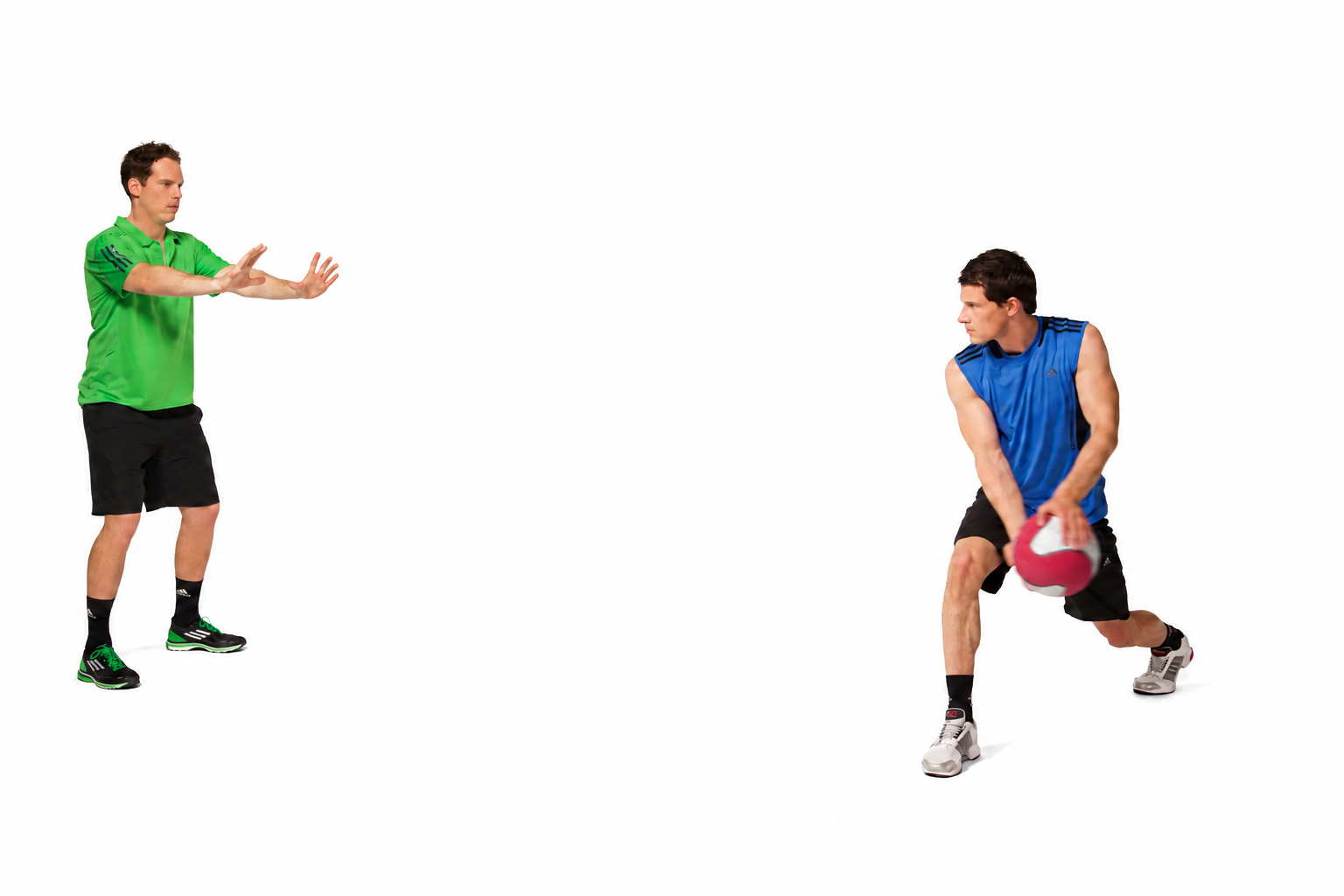
II uses a diagonal lunge with the front foot flat and weight directed through its heel. Retain the rotation and hip-height release while controlling the lunge. III uses a diagonal single-leg stance and keeps the same supporting leg after release. IV adds a side-step into the right-foot diagonal lunge, then brings the free hip forward and finishes on the left foot; retrieve the ball, side-step to the other side and reverse the starting leg. V follows that alternating route from single-leg support. Establish the fixed stance before adding the side-step and opposite-foot finish.
Technique Photographs

Book Progressions
7.109 — Medicine Ball Trunk Twist Throw (I)
Perform the rotational throw from a bilateral athletic stance, coordinating hip extension and trunk rotation with the release.
7.110 — Mb Trunk Twist Throw (Ii): Diagonal Lunge
Maintain a diagonal lunge while coordinating trunk rotation and a two-handed throw near hip level.
7.111 — Mb Trunk Twist Throw (Iii): Single-Leg
Throw from a diagonal single-leg stance and retain single-leg support after release.
7.112 — Mb Trunk Twist Thr. (Iv): Altern. Diag. Lunge
Side-step left, enter a right-foot diagonal lunge, throw and transfer onto the left foot. Retrieve the ball, side-step to the other side and reverse the starting-leg arrangement.
7.113 — Mb Trunk Twist Throw (V): Alternate Sl
Side-step left and establish right-leg support before throwing. Bring the free left hip forward and transfer onto the left leg. Reset on the other side and reverse the supporting-leg arrangement.
Choose The Load And Progression
Use a medicine ball that permits the prescribed throw, support position and recovery. Reduce ball mass or simplify support when the athlete loses balance or cannot control the return.
Historical equipment ranges in the original book are not starting-load prescriptions. Establish the movement and support position before increasing load or return frequency. Do not change support difficulty and load together simply to reach a higher numbered level.