Depth Jumps To Lateral Box Jumps | Exercises 7.178–7.181
Book exercises 7.178–7.181 from Advanced Concepts of Strength & Conditioning for Tennis.
Illustrated Exercise Instructions
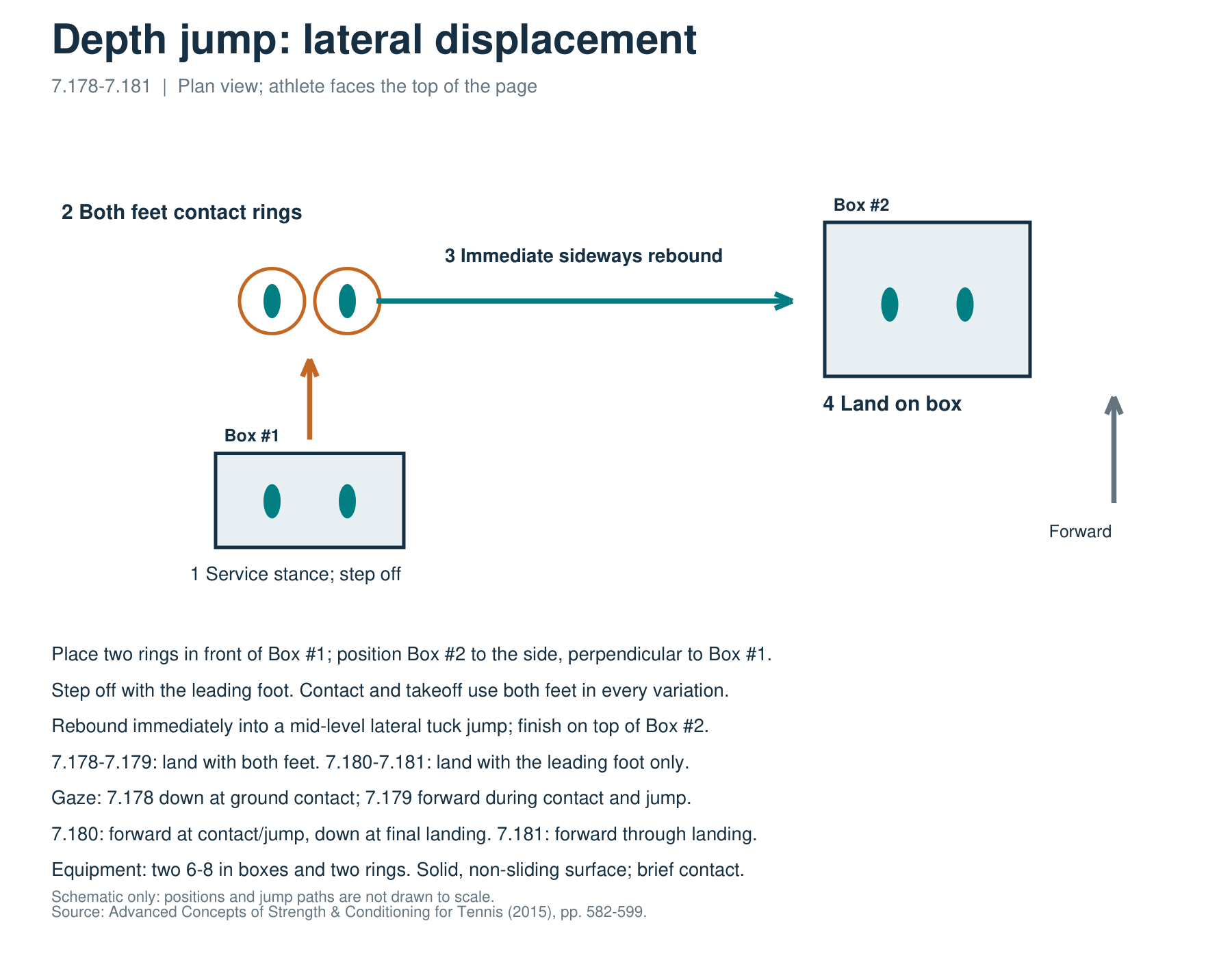
Use the diagram alongside the instructions below to identify the route, foot contacts, gaze and landing conditions for your selected progression.
Lateral Route
Use two stable 6-8-inch boxes, with box 2 perpendicular to box 1 and two rings in front of box 1. Start in the service stance. Step off with the leading foot, land on both feet together in the rings, then immediately jump sideways from both feet into a mid-level tuck onto box 2. I-II finish on both feet; III-IV finish on the leading foot.
Control the two-foot drop contact, immediate lateral rebound and
final box landing. Preparation: Low-Level Depth Jump to Full Extension I
(7.172) and Mid-Level Lateral Tuck Jump I (7.225).
Progressions
- ID
- 7.178
- Stage / Variation
- LOW-LEVEL DEPTH JUMP TO LATERAL BOX JUMP (I)
- What changes
- The exercise links a two-leg drop landing to a lateral box jump and
a two-leg final landing. Athlete looks down during ground contact.
- ID
- 7.179
- Stage / Variation
- LOW-LEVEL DEPTH JUMP TO LATERAL BOX JUMP (II)
- What changes
- The exercise links a two-leg drop landing to a lateral box jump and
a two-leg final landing. Athlete looks forward during ground contact and
the lateral jump.
- ID
- 7.180
- Stage / Variation
- LL DEPTH JUMP TO LAT. BOX JUMP: SL LANDING (III)
- What changes
- The exercise links a two-leg drop landing to a lateral box jump and
a single-leg final landing. Athlete looks forward during ground contact
and the jump, then down at the final box landing.
- ID
- 7.181
- Stage / Variation
- LL DEPTH JUMP TO LAT. BOX JUMP: SL LANDING (IV)
- What changes
- The exercise links a two-leg drop landing to a lateral box jump and
a single-leg final landing. Athlete looks forward during ground contact,
the jump and the final box landing.
Related Training Resources
Compare related tasks in the training category and use the workout library for session context. Retain the selected level, equipment and execution conditions in the training record.
Related Exercise Families
Use related pages for their stated tasks. A loaded variation, a firm-floor preparation or a separate test does not replace the setup prescribed here.
Photographs and Diagrams
The illustrations show the stated positions and routes. Follow the variation instructions for gaze, contacts and landing conditions.