
8-Way Ring Drill IV For Tennis | Exercise 7.273
A coach-called agility drill using four numbered rings around the Service T. The athlete holds a racquet and responds to an audible destination cue.
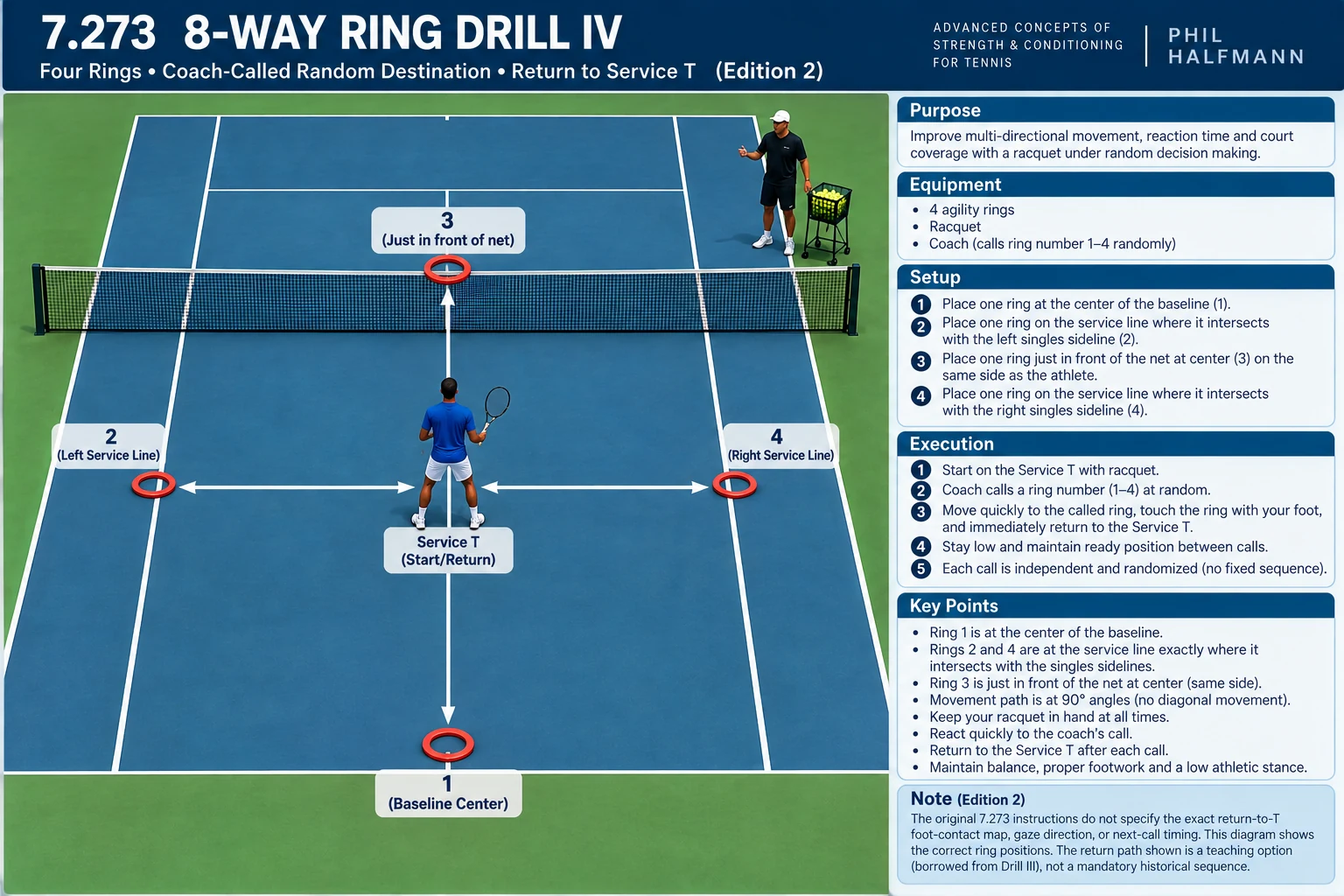
Setup
Place four agility rings around the Service T: ring 1 at the center of the baseline; ring 2 centered where the service line intersects the left singles sideline; ring 3 centered just in front of the net on the athlete’s side; and ring 4 centered where the service line intersects the right singles sideline. The athlete starts on the Service T. Keep the complete route on the starting side of the net.
How To Perform
- Start at the Service T facing the net with the racquet controlled.
- A coach or partner randomly calls ring number 1–4.
- Move to the called ring using the agreed movement pattern and reach the ring center before reversing.
- Use a controlled contact and push-off. Perform the prescribed split-step before the next direction change.
Edition 2 Teaching Option
For a structured progression from Drill III, return to the Service T after each called ring and split-step before the next call. The outward/return movement pairs from Drill III may be retained. This return-to-T procedure is an Edition 2 teaching proposal: the original Drill IV does not specify the complete return map, anatomical foot contacts, gaze direction, cue timing, or dose.
Equipment
Four agility rings, one racquet, and a coach or partner.
Key Factors
- Respond to the cue rather than anticipating a memorized order.
- Reach the ring center before reversing.
- Keep side-step and carioca patterns distinct when those patterns are assigned.
- Maintain control of the racquet and the arrival contact.
8-Way Progressions — 7.270–7.273
I follows ring 1 → return to T → ring 2 → return → ring 3 → return → ring 4 → return, without a racquet and with downward gaze. Backpedal to ring 1 and sprint back; side-step left to ring 2 and return by carioca; sprint to ring 3 and backpedal back; side-step right to ring 4 and return by carioca. Split-step at each return. Ring 2 uses the left-foot contact and ring 3 and ring 4 use the right foot; push off the contacting foot.
II retains the route and downward gaze while carrying a racquet and recording time. III retains that timed circuit with forward gaze. IV uses random audible calls with a racquet. Returning to T after each called destination is the stated second-edition teaching option; the original IV does not specify a complete return map or timing protocol. The planned circuit and the random-cue task require separate records.
Book Reference
Exercise 7.273 in Advanced Concepts of Strength & Conditioning for Tennis, Second Edition. The audible cue adds a stimulus-response demand, but a numbered call does not reproduce reading an opponent or ball flight.