
2 Shots & Ladder + Volley I–IV For Tennis | Exercises 7.66–7.69
A four-level progression combining controlled baseline ring contacts, a return to center, a short-ladder approach, split-step organization, and—at the later levels—fed groundstrokes and a lunge-volley.

Movement Components
The video combines three separately recorded studio components: groundstroke preparation and swings, Fast Feet through the ladder, and a split-step followed by a simulated volley. It does not show a continuous six-ring court route, coach-fed balls, or the Level IV target. Use the court diagram and written I–IV progression for those requirements.
Technique Photos
These photos show the ready stance and ring foot placement. Use the court diagram and written progression for the complete route and variation requirements.

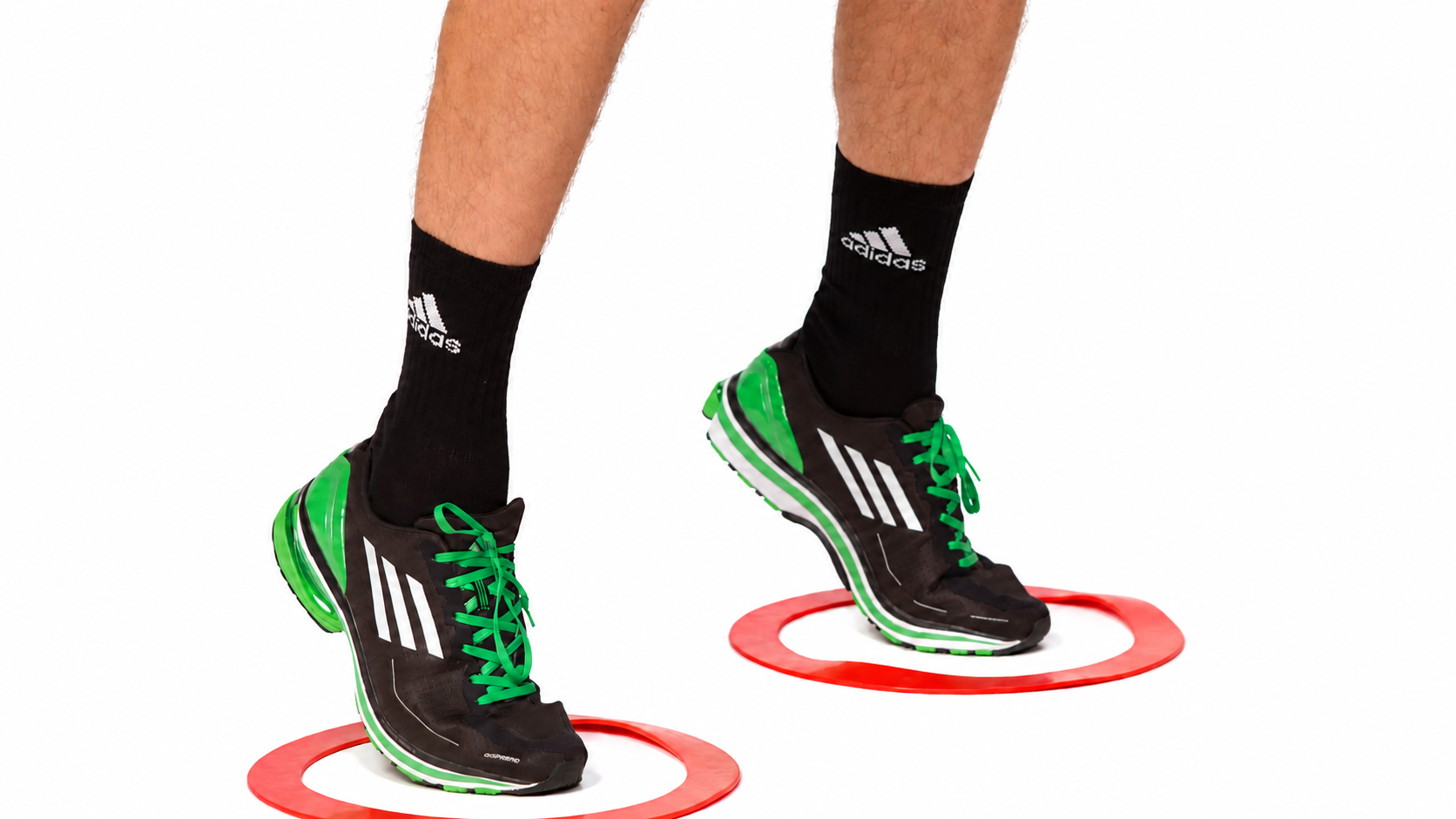
Core Setup
Use six agility rings and one short speed ladder. Rings 1 and 2 are positioned wide to the left and right along the baseline for the two groundstroke movements. Rings 3 and 4 are positioned around the Service T for the split-step. From there, the athlete takes a few quick Fast Feet steps forward through the short ladder before transitioning to the forehand or backhand volley. Later versions add live feeds and, in IV, a four-cone volley target.
Progression
I — 7.66: rehearse the route without a racquet or feed. Land on the right foot at the deuce-side baseline ring and the left foot at the ad-side ring, stabilizing each landing before pushing off. Return to centre, split-step in the service-T rings, use the short Fast Feet ladder toward the volley and rehearse the lunge. Look toward the ladder contacts while learning the sequence.
II — 7.67: add a racquet, retain downward gaze through the ladder and simulate the lunge-volley without a ball feed.
III — 7.68: add three coach-fed balls in order: forehand-side groundstroke, backhand-side groundstroke and forehand or backhand lunge-volley. Retain the centre return, service-T split-step and short ladder toward the volley. Look forward during the ladder contacts.
IV — 7.69: retain the three-ball sequence and visually track the coach during the ladder approach. Direct the final lunge-volley toward a defined four-cone target.
Volley Footwork
For a forehand volley, the left foot leads forward. For a backhand volley, the right foot leads forward. The feed, handedness and ring placement must permit the intended stroke rather than forcing the athlete into the wrong lead-foot pattern.
Key Factors
- Land on the prescribed foot at each baseline station and gain control before the next action.
- Return to center before entering the ladder; do not cut diagonally from the second baseline station.
- Complete the split-step at rings 3 and 4 around the Service T, then perform the Fast Feet pattern forward through the short ladder before moving into the volley.
- Coordinate the split-step and volley movement with the live feed in III and IV.
- Use a balanced recovery and reset rather than ending the demonstration immediately after ball contact.
Equipment
Six agility rings and one short speed ladder. II adds a racquet. III–IV also require tennis balls and a coach/feeder; IV adds four cones for the target.
Book Reference
Exercises 7.66–7.69 in Advanced Concepts of Strength & Conditioning for Tennis, Second Edition. No universal repetition count, landing-hold time or work-to-rest ratio is established for this exact series.